
Tickwise
AI-Assisted Marking for Teachers
Tickwise reads handwritten or typed scripts, drafts marks and comments against the department's rubric, and hands them to the teacher to accept, edit or reject. Nothing reaches a student until a teacher approves and publishes it.
What it is
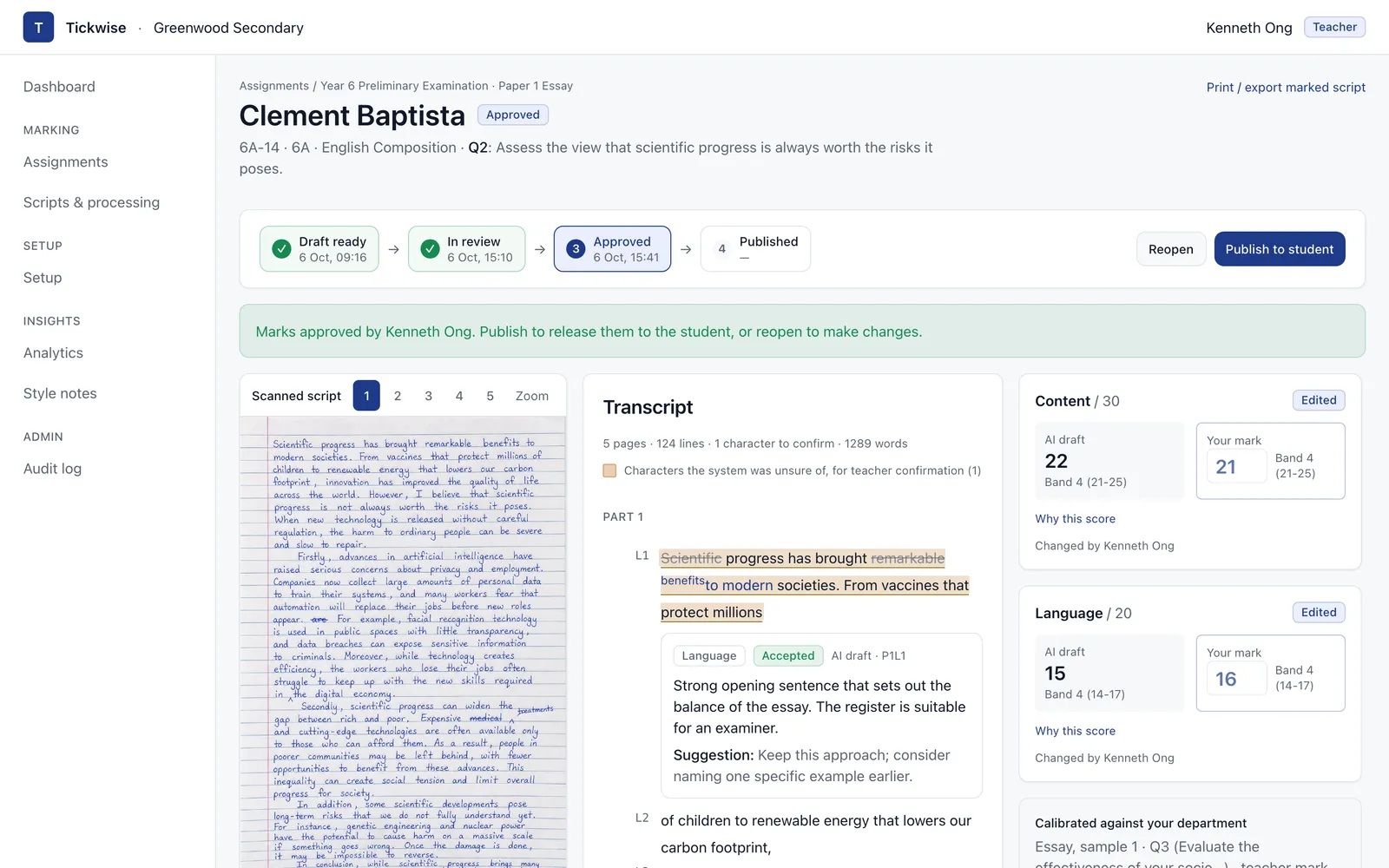
Tickwise is a marking workbench for teachers and heads of department. Teachers upload a class set of scripts. Tickwise transcribes them, drafts a score for each rubric criterion with its reasons, and suggests comments anchored to specific lines. The teacher makes every final decision.
The problem it solves
Marking a class set of essays well means a score that matches the rubric and comments a student can act on. That takes hours per set, and the comments get shorter as the evening gets later. Departments also want consistent marks across teachers, which is hard to check by hand.
What it does
- Handwritten and digital scripts. Upload scans of handwritten work, or PDF and Word files. The transcript sits beside the scan, with any characters the system was unsure of highlighted for the teacher to confirm.
- Draft marks against the rubric. A draft score and band for each criterion, with a "Why this score" explanation the teacher can check.
- Comments the teacher controls. Suggested comments are anchored to lines in the script. The teacher accepts, edits or rejects each one, and can add their own on any passage.
- Approval before release. A result cannot be published to a student until a teacher approves it, and the database enforces this rule as well as the screen.
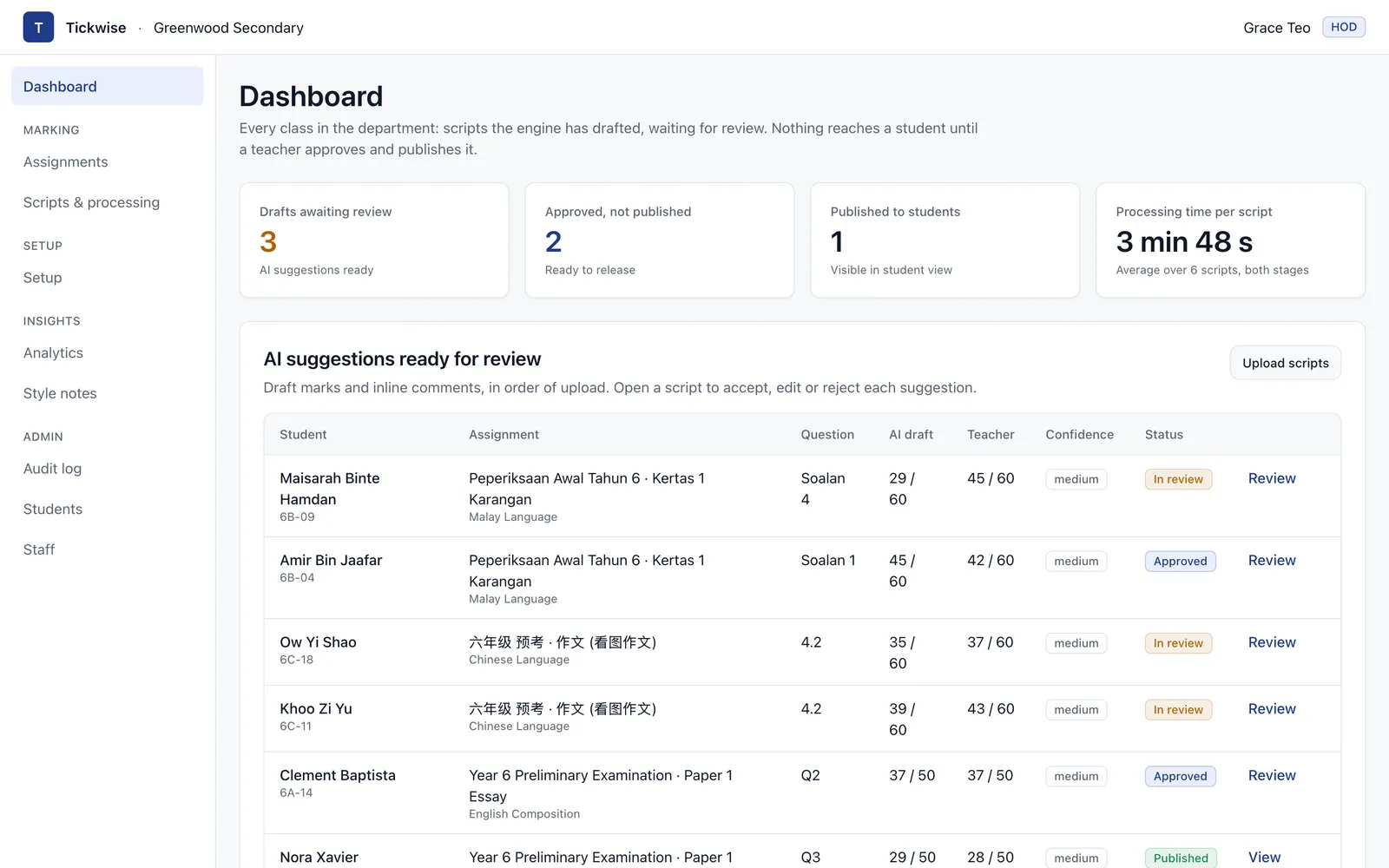
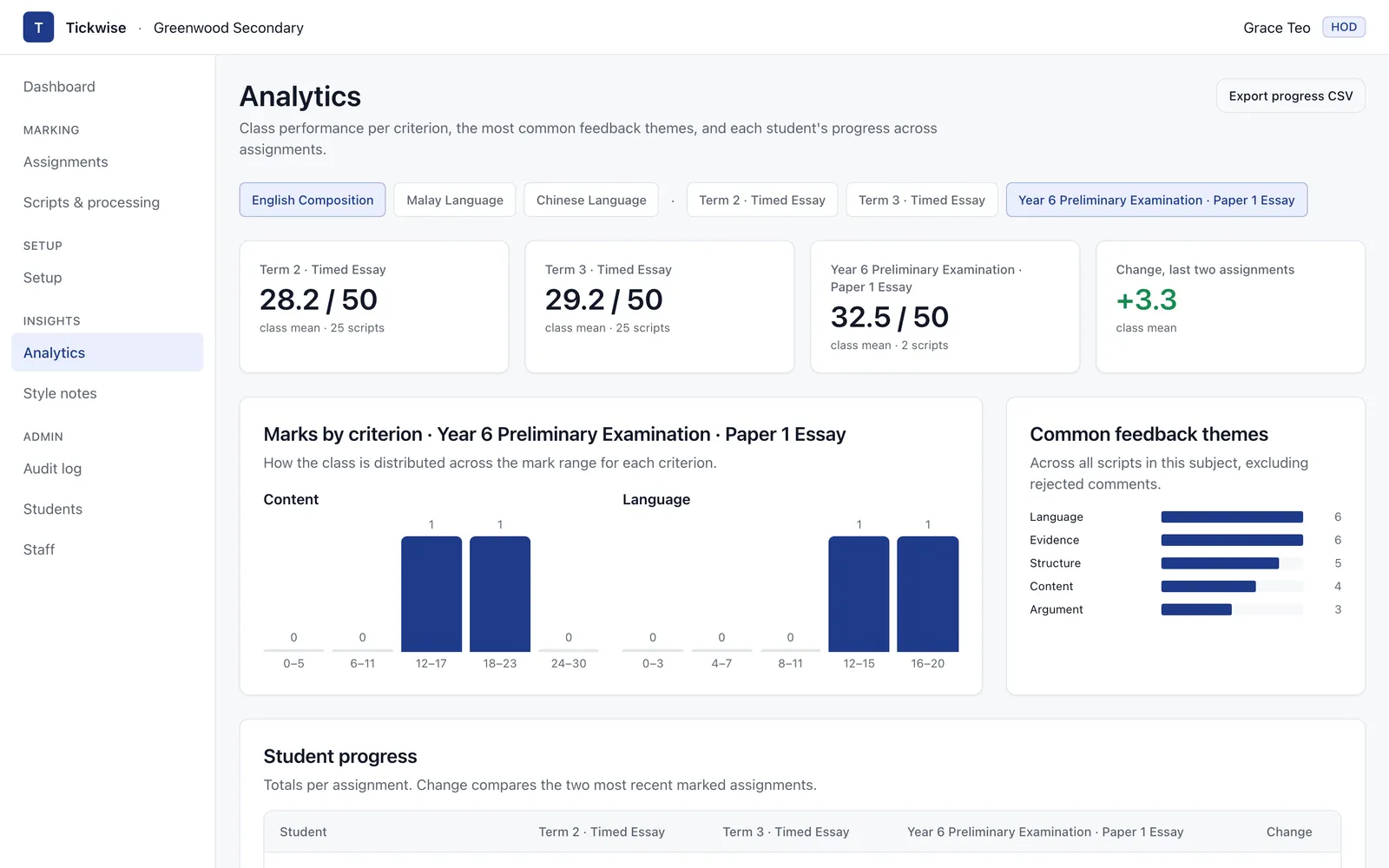
- Consistency for heads of department. Calibrate with scripts the department has already marked, compare draft marks with teachers' marks, and see the teacher's style notes the system learns from their edits.
- Full audit trail. Every change to a score or comment is logged with its before and after values, and who made it.
Works with essays and language papers in English, Chinese and Malay.
How it's built
- Stack: Next.js 16 and TypeScript, Tailwind CSS, Supabase (Postgres, Auth and file storage), and a two-stage AI pipeline (transcribe, then mark) behind a swappable provider.
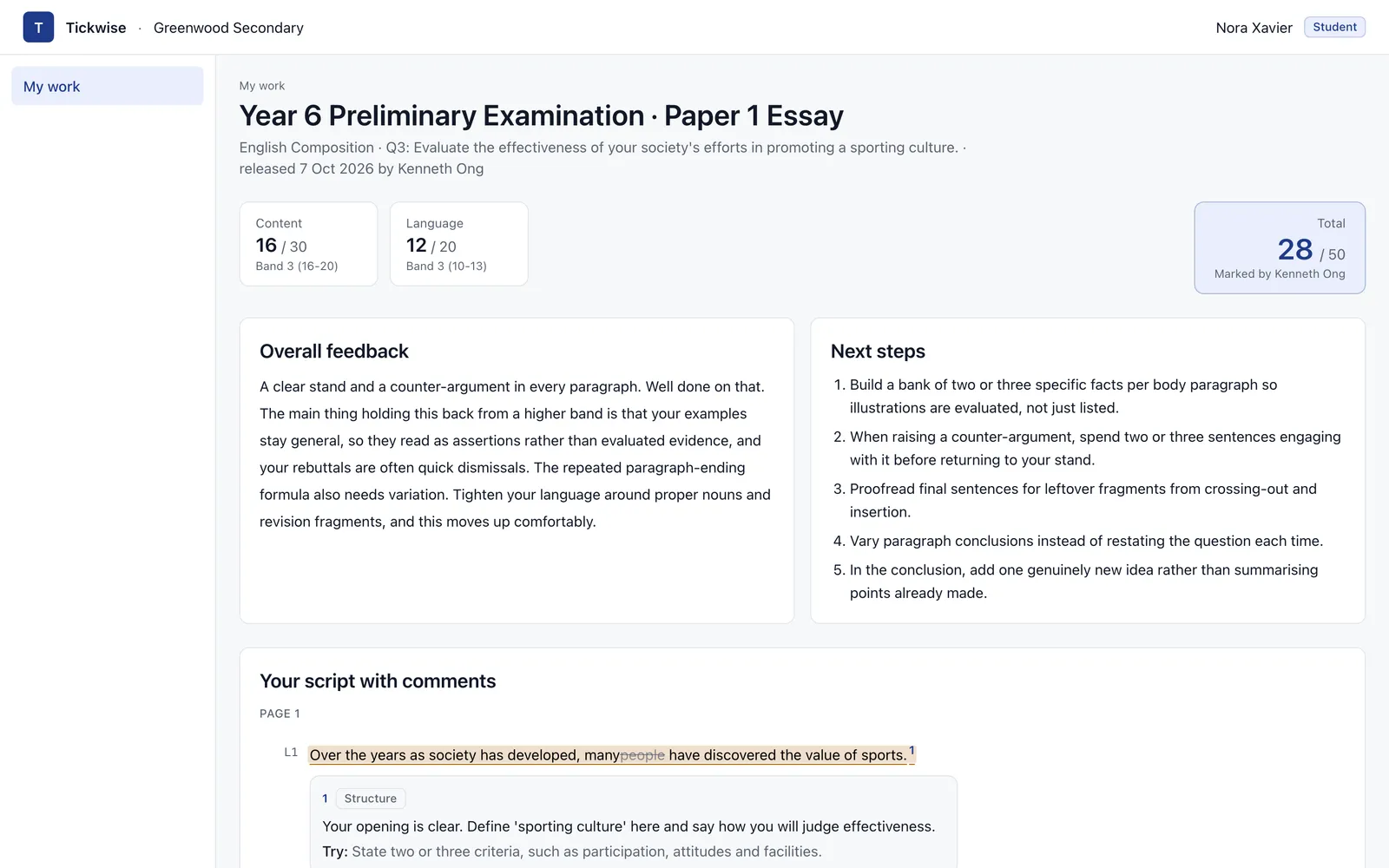
- Access control: roles for heads of department, teachers and students, enforced by row-level security. A student sees only their own published result.
- Release workflow: each script moves through fixed states (uploaded, transcribing, marking, drafted, in review, approved, published). A database trigger blocks any skipped step.
- Personal data: student names are not sent to the AI model. The audit log is append-only.
- Hosting: can be hosted in Singapore (Supabase ap-southeast-1). The AI model provider is chosen per deployment, and we confirm where it processes scripts before go-live.
Screens
Want marking help that keeps teachers in charge?
Email us about your subjects and how your department marks today. We reply the same working day.
Email us